AEO vs GEO: What's the Actual Difference (And Which One Should You Care About)?
 Written by Martin J.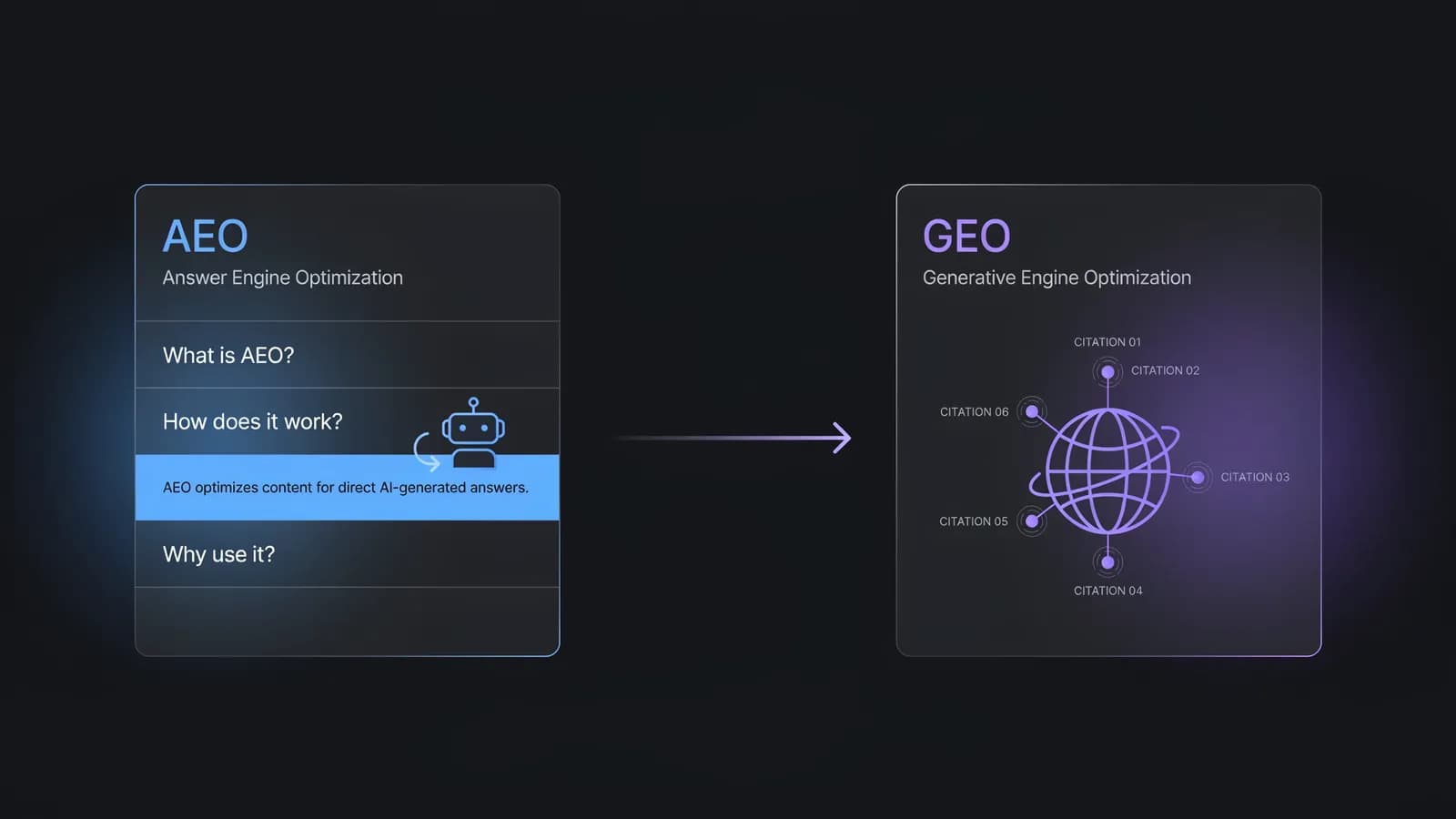
You have been told to optimize for AI search. Half your colleagues say AEO. The other half say GEO. They are not the same thing — and the one your agency is billing you for may not be the one you actually need.
Most articles stop at definitions. This one doesn’t. By the end, you’ll have a checklist for each discipline, a tool comparison with pricing, and a clear answer to the question nobody seems willing to give: which should you actually run first?
One data point sets the stakes. Ahrefs found that 80% of LLM citations come from pages that don’t rank in Google’s top 100 for the original query. AI systems are not just rewarding the same sites you’ve been building links for. The game has genuinely changed — and AEO and GEO address two different parts of it.
What Is AEO? (And Why the Definition Keeps Changing)
AEO meaning: Answer Engine Optimization is the practice of structuring content so that AI-powered search platforms select it as a cited source when generating answers.
The term predates generative AI. Early AEO meant optimizing for Google’s featured snippets, Alexa voice answers, and Siri queries — the “answer box” era. You formatted content as a question-answer pair, added FAQ schema, and aimed to own the zero-click result.
In 2026, the definition has expanded. AEO now targets Google AI Overviews, ChatGPT search, Perplexity, and Claude — any system that generates a direct answer rather than returning a list of links. The underlying logic is the same: format your content so machines can extract and cite it. The surface area is just much larger.
What does AEO stand for? It stands for Answer Engine Optimization — not a ranking strategy, but a citation strategy. Your goal is not position 1. It’s being quoted.
AEO targets specific question moments. A user types “what’s the best project management tool for remote teams?” into ChatGPT. AEO is what determines whether your content appears in that answer. It operates at the query level: one question, one answer format, one citation opportunity.
Key signals that AEO content works:
- Direct-answer paragraphs that open with the answer, not the context
- Question-based H2 and H3 headings
- FAQ schema markup on high-traffic pages
- Content under 100 words that answers a specific question cleanly
ChatGPT now handles over 2 billion queries daily (OpenAI, 2026). That’s 2 billion opportunities for your content to appear — or not.
What Is GEO? Generative Engine Optimization Explained
GEO definition: Generative Engine Optimization is the practice of building brand authority and content depth so that AI systems cite, mention, and recommend your brand across generative responses — not just for one query, but across a category.
GEO was coined in a 2024 Princeton, Georgia Tech, and IIT Delhi research paper published at KDD 2024 (Aggarwal et al.). The researchers tested which content modifications improved AI citation rates. Their top three: adding statistics, citing sources, and including direct quotations from authorities. These tactics lifted AI visibility by up to 40% — and for mid-ranked pages, citation rates improved by 115%.
GEO operates at the brand level. It’s not about answering “what’s the best project management tool?” It’s about being the brand that AI systems consistently associate with project management software — whether the query is “best tool for remote teams,” “how to track OKRs,” or “project management for startups.” AEO wins a moment. GEO builds a reputation.
The core GEO tactics:
- E-E-A-T signals: Author credentials, first-party research, case studies with named outcomes
- Brand mention breadth: Being cited across multiple credible domains (not just ranked in Google)
- Structured authority content: Whitepapers, original studies, expert-sourced articles
- Topical depth: Comprehensive coverage of a subject so AI systems learn to associate your brand with that category
GEO is slower than AEO. Expect a 2–4 month window before you see measurable citation share shifts. This is not a quick win — it’s infrastructure.
If you’re building an agentic marketing stack where AI systems are making decisions on behalf of your brand, GEO is how you train those systems to know who you are.

AEO vs GEO — The 5 Key Differences
Dimension | AEO | GEO |
|---|---|---|
Primary target | Specific questions / queries | Brand-level authority & category association |
Optimization focus | Content format, structure, Q&A pairs | Backlinks, brand mentions, E-E-A-T signals |
Measurement | Featured snippet rate, AI answer inclusion per query | AI citation rate, brand mention share in generative responses |
Timeframe | Weeks (content updates, schema changes) | Months (authority building, PR, link acquisition) |
Who owns it | Content team | SEO + PR + brand team |
The simplest way to remember the difference: AEO is what you say. GEO is who you are.
A page optimized for AEO answers one question well. A brand optimized for GEO earns mentions it didn’t even ask for.
Both matter. The question is sequencing — which comes first for your situation. (We’ll cover that in the decision framework section below.)
Is SEO Still Relevant? AEO vs GEO vs SEO Compared
Yes. Traditional SEO is not dead — it’s the foundation that makes AEO and GEO possible.
Here’s the framework:
- SEO = infrastructure. Technical health, crawlability, Core Web Vitals, internal linking, keyword targeting. If your site is technically broken, AEO and GEO don’t work.
- AEO = content execution. How you write, structure, and format individual pages to win citation moments.
- GEO = authority strategy. The off-page, brand-level signals that make AI systems trust your domain across an entire topic category.
Think of it as a stack. SEO is the foundation. AEO is the ground floor. GEO is what you build on top.
One counter-intuitive finding from 2026 data: AI citation logic is decoupling from traditional organic rankings. Conductor’s analysis of 21.9 million queries found that Google AI Overviews now appear in 25.11% of US searches (up from 13.14% in March 2025). And the sources AI Overviews cite? Only 38% come from pages in Google’s top 10 — down from 76% in earlier measurements.
This means two things. First, you can earn AI citations without ranking first. Second, ranking first no longer guarantees AI visibility. The overlap between “SEO winner” and “AEO/GEO winner” is shrinking.
The strategic response: treat AEO and GEO not as replacements for SEO, but as parallel tracks that require distinct measurement and distinct tactics. Running all three looks like this:
SEO | AEO | GEO | |
|---|---|---|---|
Success metric | Organic rankings, traffic | AI citation rate, featured snippet ownership | Brand mention share in AI responses |
Primary lever | Technical optimization + backlinks | Content structure + FAQ schema | E-E-A-T + PR + first-party research |
Time to impact | 3–6 months | 4–8 weeks | 2–4 months |
How to Execute AEO in 2026 — Practitioner Checklist
AEO execution is a content and structure problem. Here’s what works, based on published citation data:
✅ Content structure
- Add a direct-answer paragraph to every important page. Open with the answer in 1–2 sentences. Never bury the lead.
- Rewrite H2 and H3 headings as questions your audience actually types (“What is AEO?”, “How does AEO differ from SEO?”)
- Keep definitions under 60 words. AI engines extract the clearest, shortest answer — not the most comprehensive one.
- Use numbered and bulleted lists. These are machine-readable and extract cleanly.
✅ Schema and technical
- Add FAQ schema to every page targeting question-based keywords
- Add HowTo schema to process or tutorial pages
- Keep page load under 2.5 seconds — AI crawlers deprioritize slow pages
- Maintain fresh publication and update dates — Ahrefs found AI-cited URLs are 25.7% fresher than traditional search results
✅ Monitoring
- Track your brand mentions in Perplexity, ChatGPT, and Google AI Mode weekly
- Use an AI visibility tool (see Tools section below) to measure citation share per query
- Set up UTM tracking for AI referral traffic — it converts at 14.2% vs 2.8% for organic (Similarweb 2026)
One thing to stop doing: chasing AI Overviews with keyword stuffing. The Princeton/Georgia Tech GEO study found that “Keyword Stuffing” had near-zero effect on AI citation rates. Clean, factual, well-cited content outperforms keyword-heavy content in AI answers consistently.
For deeper context on building AI-optimized content, see our guide to AI content creation.
How to Execute GEO in 2026 — Practitioner Checklist
GEO is an authority and brand problem. It’s slower than AEO — but the compounding effects are larger.
✅ Brand presence audit
- Ask ChatGPT and Perplexity: “What are the best [your category] tools?” — does your brand appear?
- Ask: “What do people say about [your brand name]?” — what does the AI say?
- Run the same prompts monthly to track mention share shifts over time.
✅ Content and E-E-A-T
- Publish original first-party research (surveys, proprietary data, case studies with named metrics)
- Add detailed author bios with credentials to every key article — AI systems weight expertise signals
- Include external citations in your content (statistics from Gartner, Forrester, academic papers) — the KDD 2024 GEO study found “Cite Sources” was among the top tactics for improving citation rates
- Quote external experts — “Quotation Addition” was a top-3 GEO tactic in the Princeton study
✅ Off-page signals
- Earn coverage in credible third-party publications (trade press, industry blogs, academic citations)
- Build brand mentions — not just backlinks. AI systems read web text, not just link graphs.
- PR strategy targeting publications that AI systems frequently cite (e.g., Harvard Business Review, Gartner, Forrester, industry trade publications)
✅ Topical authority
- Create comprehensive cluster content — pillar + spokes — that covers every angle of your core topic
- Update your most authoritative content quarterly with new data
- Aim to earn citations from 20+ high-authority domains per quarter (Profound benchmark)
The 56% of digital marketing leaders who reported high GEO investment in 2025, and the 94% planning to increase it in 2026 (Conductor), are building brand authority now — before it gets crowded.
AEO vs GEO Tools Compared (2026)
The tool landscape is still fragmented. No single platform covers both AEO monitoring and GEO authority measurement equally well.
Tool | AEO Features | GEO Features | Pricing |
|---|---|---|---|
Allable | AI Overview tracking, AI citation monitoring per query, featured snippet analysis | Brand mention share in AI responses, cross-platform visibility dashboard | From $49/mo |
Profound | AI citation monitoring (ChatGPT, Perplexity, Gemini) | Brand mention analytics, share-of-voice in AI answers | From $149/mo |
SE Ranking | AEO module — FAQ schema checker, featured snippet tracking | Limited GEO features | From $65/mo |
Semrush AI Toolkit | AI Overviews visibility tracking | Brand mention monitoring (limited) | From $139/mo (add-on) |
Otterly | AI search visibility monitoring | Brand mention frequency across LLMs | From $99/mo |
For most mid-size marketing teams: Start with Allable for combined AEO + GEO tracking. Add Profound if you need deeper competitive citation benchmarking. Use SE Ranking’s AEO module if you’re primarily focused on Google AI Overviews and featured snippets.
The best AI SEO tools for your stack depend on whether your priority is winning individual query answers (AEO focus) or building category authority over time (GEO focus). Most teams end up running both tracks simultaneously.
Which Should You Focus On First? — Decision Framework
This is the question that every article on this topic avoids. Here is a direct answer:
Start with AEO if:
- You have existing content that already targets question-based keywords
- You want measurable wins within 4–8 weeks
- Your team has content writers but limited PR or link-building capacity
- You’re a new brand or recently launched product
AEO is faster and more controllable. You update a page, add schema, restructure the format — and you can measure citation rate changes within weeks. It’s the highest-ROI starting point for most teams.
Run GEO in parallel if:
- You’re in a competitive category where brand authority matters
- Your brand is not appearing when AI systems describe your market
- You have the budget for PR, research production, and link building
- You’re playing a 6–12 month authority game
GEO is not optional for established brands. If AI systems don’t know who you are, your competitors’ brands fill that space. The 5x conversion premium of AI referral traffic (14.2% vs 2.8% organic) is only valuable if you’re being cited.
If you’re starting from scratch:
Run this sequence:
- Fix your SEO foundation first (technical health, site speed, crawlability)
- Launch AEO on your highest-traffic pages (FAQ schema, direct-answer intros, question headings)
- Start GEO in month 2–3 (original research, author bios, PR outreach)
Neither AEO nor GEO replaces the other. They operate on different timeframes and different layers of the AI search stack. Brands winning AI visibility in 2026 are running both.
FAQ
Is AEO the same as GEO?
No. AEO and GEO address different problems. AEO targets specific question-answer moments — getting cited when someone asks a particular query. GEO builds brand-level authority so AI systems associate your brand with a category over time. AEO is a content strategy. GEO is an authority strategy. You need both, but they have different owners, different timelines, and different measurement metrics.
How do I measure AEO results?
Track featured snippet ownership for your target queries. Monitor AI answer inclusion in Google AI Overviews, ChatGPT search, and Perplexity using a dedicated AI visibility tool. Also track UTM-tagged referral traffic from AI platforms — it converts at 14.2% vs 2.8% for organic search (Similarweb 2026). Watch for AI citation appearances in your core query set month-over-month.
How do I measure GEO results?
GEO measurement is harder because it’s brand-level. Track brand mention share in AI responses using Profound or Allable’s brand visibility dashboard. Ask AI platforms directly about your category (“What are the best [your category] platforms?”) and note whether your brand appears. Benchmark monthly. Also track referral traffic from AI platforms as a proxy for citation volume.
Which is harder — AEO or GEO?
AEO is faster to implement. You can restructure a page, add FAQ schema, and rewrite headings in a day. GEO requires months of authority building — original research, PR, third-party citations. That said, GEO compounds more powerfully over time. A brand that earns category association in AI systems is harder to displace than a brand that wins a single featured snippet.
What generative engine optimization tools are available in 2026?
The main tools are Allable (combined AEO + GEO monitoring), Profound (AI citation tracking and brand mention share), SE Ranking (AEO module for Google features), Semrush AI Toolkit (AI Overviews visibility), and Otterly (AI search monitoring). Most enterprise teams run 2–3 tools because no single platform covers both disciplines completely. See the tool comparison table above for pricing.
The Bottom Line
AEO and GEO are not synonyms. They are not interchangeable. And “optimize for AI search” is not a strategy — it’s a direction.
AEO wins the moment: structured content, clear answers, FAQ schema, query-level citation. Measurable in weeks.
GEO wins the category: original research, brand authority, third-party mentions, E-E-A-T depth. Measurable in months.
The brands building AI visibility right now are running both — with AEO as the quick-start layer and GEO as the compounding long-term play. With 94% of digital marketing leaders increasing GEO investment in 2026, the window to build first-mover advantage is narrowing.
Ready to track your AEO and GEO performance in one dashboard? Start with Allable — AI citation monitoring, brand mention share, and AI Overviews tracking across ChatGPT, Perplexity, and Google, all in one place.